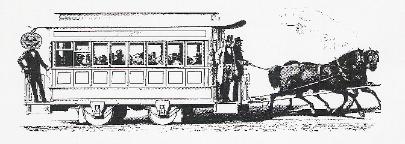
| A Primer on Trolleys (and why they are called "Trolleys"?) In the beginning there were feet and people traveled "shanks mare"....some people would be carried on litters or palanquins but mostly people walked from place to place...slowly. For some there were horses, chariots, wagons and carriages, and after a certain point, stagecoaches and omnibuses (larger coaches carrying members of the general public over a fixed route for a fixed fee). In Philadelphia, "Boxall's Accommodation" began service in 1831, running an hourly stage between 7th and Chestnut Streets to the Merchant's Coffee House on Second street, and in Darby, an omnibus ran between Darby and 6th and Market Streets as seen in an advertisement from 1837. |
Winter Arrangement
The subscriber respectfully informs the inhabitants of Darby, Philadelphia and their vicinities that on and after the 25th of
September he will continue to run his line of omnibusses regularly between the above mentioned places leaving each point as
follows: Leaves the public house of the subscriber at Darby everyday at 8:00 o'clock A.M. and 2 o'clock P.M. for Philadelphia
returning leaves Mr. J. Douglasses Pennsylvania Hotel, sixth Street above Market at 10 o"clock A.M. and 4:00 P.M. calling for
passengers at Mr. D. Millers Western Hotel , Market Street above Eighth, crossing over the permanent bridge.
September he will continue to run his line of omnibusses regularly between the above mentioned places leaving each point as
follows: Leaves the public house of the subscriber at Darby everyday at 8:00 o'clock A.M. and 2 o'clock P.M. for Philadelphia
returning leaves Mr. J. Douglasses Pennsylvania Hotel, sixth Street above Market at 10 o"clock A.M. and 4:00 P.M. calling for
passengers at Mr. D. Millers Western Hotel , Market Street above Eighth, crossing over the permanent bridge.
Passengers desirous of taking seats in the omnibus will be called for and taken to their residence by leaving word with the
undersigned.
undersigned.
The Proprietor returns his thanks for the patronage so liberally bestowed upon him, and assures the public that nothing shall be
wanted, on his part, to render this line worthy of support.
wanted, on his part, to render this line worthy of support.
John Smith
Darby, Sept. 15, 1837 -tf
(From the Delaware County Republican and Farmers, Mechanics, and Manufacturers Advocate, published at Darby, PA by Y.S.
Walter, February 9, 1838- Thanks to Tom Smith at Sellers Library)
Walter, February 9, 1838- Thanks to Tom Smith at Sellers Library)
In France, at around this time, carriages were set on rails which resulting in the first street railways (and a much smoother
ride). The idea caught on, and by the middle of the century, horse-car lines were operating in many cities throughout the United
States. One of the earliest was in Baltimore in 1828. In Philadelphia, the first horsecar line began operating on January 21,
1858 when 15 cars were put into service over the 5th and 6th Street Route of the Philadelphia and Delaware Railroad
Company, from 6th and Montgomery in Kensington to Morris Street in the village of Southwark (J.H.M. Andrews Short History of
the Development of Street Railway Transportation in Philadelphia (1945)).In Darby, a horse car line operated by the
Philadelphia and Darby Railroad Company between Front Street in Philadelphia and 9th and Main in Darby starting 24
December , 1858.
One unique aspect of Philadelphia Streetcars came as a result of an 1857 Act of Assembly which mandated that the space
between rails was to be 5'2" (Philadelphia Broad Gauge) and not 4'81/2" as was standard for the railroads.
From early on, there were efforts to provide motive power from sources other than horses, including self-propelled steam cars
called "steam dummys", first placed into service in 1863. Another method involved the installation of continuous cables running
underneath the streets allowing a "gripman" to grab on to the cable and be pulled along in a manner not much different than a
rope tow. Although the cable cars in San Francisco are the most widely known, Philadelphia first cable car system started in
1883, and from 1885 to 1895, a cable car ran up and down Market Street from 41st to Front.
In the 1880's an immigrant named Leo Daft developed a way of transmitting electric power to a streetcar using a small
grooved-wheel cart traveling along two overhead wires, "Trolling" along behind the car. These "Trollers" had a distressing habit
of falling off the wires (and crashing onto the car beneath) and were soon supplanted by other methods, leaving the name
"Trolley" and a legacy.
The first economically viable electric streetcar was in Richmond, Va. in 1888, and the idea soon swept the country. In
Philadelphia, the first line to be electrified was along Bainbridge street, and within a few years, all Philadelphia lines were
electrified. The Darby route was electrified May 29, 1894 and operated by the Philadelphia Traction Company, later the Union
Traction Company, the Philadelphia Rapid Transit Company and then by SEPTA The last Philadelphia horse car line ended its
run on January 15, 1897.
ride). The idea caught on, and by the middle of the century, horse-car lines were operating in many cities throughout the United
States. One of the earliest was in Baltimore in 1828. In Philadelphia, the first horsecar line began operating on January 21,
1858 when 15 cars were put into service over the 5th and 6th Street Route of the Philadelphia and Delaware Railroad
Company, from 6th and Montgomery in Kensington to Morris Street in the village of Southwark (J.H.M. Andrews Short History of
the Development of Street Railway Transportation in Philadelphia (1945)).In Darby, a horse car line operated by the
Philadelphia and Darby Railroad Company between Front Street in Philadelphia and 9th and Main in Darby starting 24
December , 1858.
One unique aspect of Philadelphia Streetcars came as a result of an 1857 Act of Assembly which mandated that the space
between rails was to be 5'2" (Philadelphia Broad Gauge) and not 4'81/2" as was standard for the railroads.
From early on, there were efforts to provide motive power from sources other than horses, including self-propelled steam cars
called "steam dummys", first placed into service in 1863. Another method involved the installation of continuous cables running
underneath the streets allowing a "gripman" to grab on to the cable and be pulled along in a manner not much different than a
rope tow. Although the cable cars in San Francisco are the most widely known, Philadelphia first cable car system started in
1883, and from 1885 to 1895, a cable car ran up and down Market Street from 41st to Front.
In the 1880's an immigrant named Leo Daft developed a way of transmitting electric power to a streetcar using a small
grooved-wheel cart traveling along two overhead wires, "Trolling" along behind the car. These "Trollers" had a distressing habit
of falling off the wires (and crashing onto the car beneath) and were soon supplanted by other methods, leaving the name
"Trolley" and a legacy.
The first economically viable electric streetcar was in Richmond, Va. in 1888, and the idea soon swept the country. In
Philadelphia, the first line to be electrified was along Bainbridge street, and within a few years, all Philadelphia lines were
electrified. The Darby route was electrified May 29, 1894 and operated by the Philadelphia Traction Company, later the Union
Traction Company, the Philadelphia Rapid Transit Company and then by SEPTA The last Philadelphia horse car line ended its
run on January 15, 1897.